1. Overview of Muscle Tissues
Muscle is one of the four primary tissue types of the body (along with epithelial, nervous, and connective tissues), and the body contains three types of muscle tissue: skeletal muscle, cardiac muscle, and smooth muscle (see Figure 1.1). All three muscle tissues have some properties in common; they all exhibit a quality called excitability as their plasma membranes can change their electrical states (from polarized to depolarized) and send an electrical wave called an action potential along the entire length of the membrane. While the nervous system can influence the excitability of cardiac and smooth muscle to some degree, skeletal muscle completely depends on signaling from the nervous system to work properly. On the other hand, both cardiac muscle and smooth muscle can respond to other stimuli, such as hormones and local stimuli.
A unique property common to all three types of muscle is contractility, which is the ability of the cells to shorten and generate force. While muscle tissue can shorten with contractions, it also displays extensibility or the ability to stretch and extend beyond the resting length of the cells. After being stretched, the elasticity of muscle allows it to recoil back to its original length.
The muscles all begin the mechanical process of contracting (shortening) when a protein called actin is pulled by a protein called myosin. In both skeletal and cardiac muscle, these proteins are arranged very regularly in the cytoplasm of individual muscle cells, which creates an alternating light and dark striped pattern called striations.
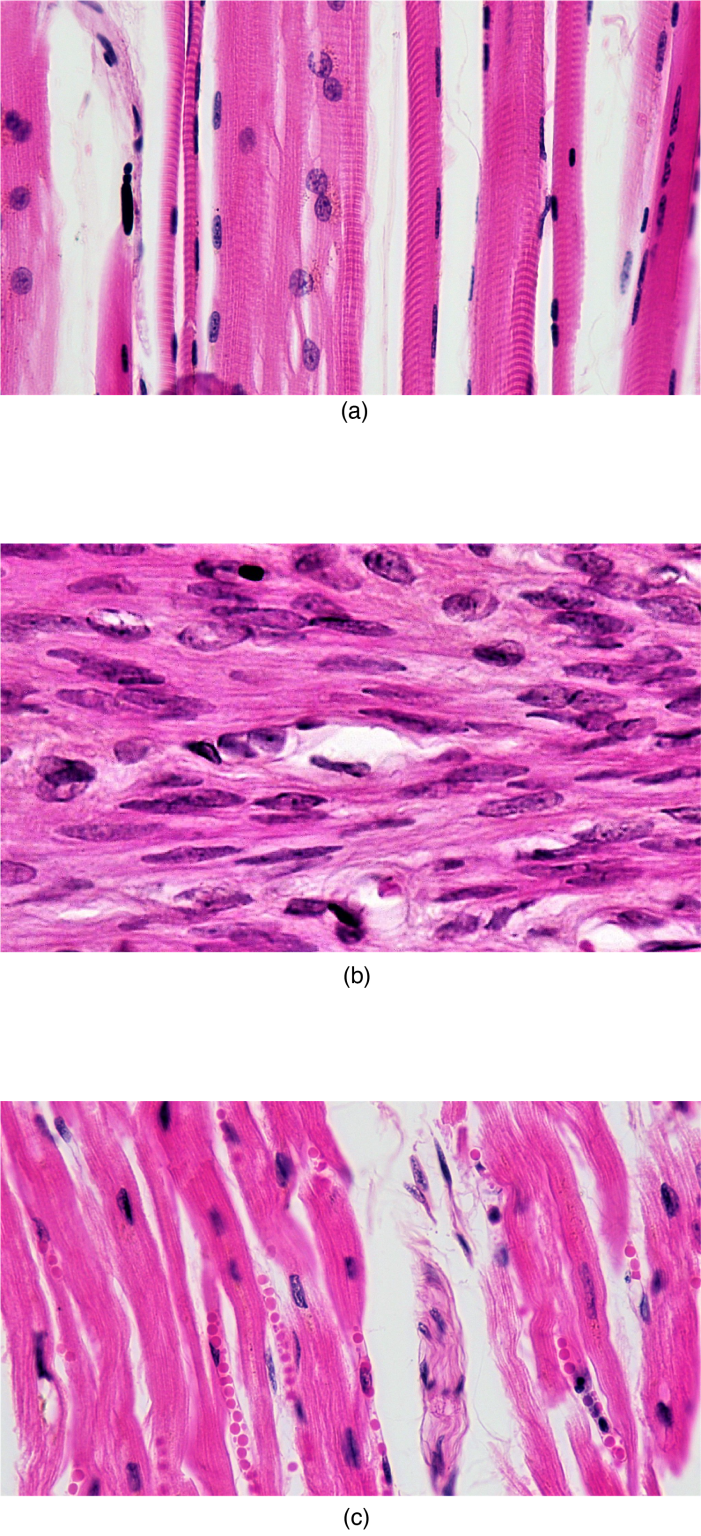
The striations are visible with a light microscope under high magnification (see Figure 1.1). Smooth muscle (named for its lack of striations) does not produce this striped pattern because the contractile proteins are not arranged in such regular fashion.
Skeletal muscle cells (also called muscle fibers) are unique in that they are multinucleated with the nuclei located on the periphery of the cell under the cell plasma membrane (also called sarcolemma in muscle).
Muscle Functions
The best-known feature of skeletal muscle is its ability to contract and cause movement. Skeletal muscles act not only to produce movement but also to stop movement, such as resisting gravity to maintain posture.
Cardiac muscle is only found in the heart and functions to generate force and build pressure gradients to drive blood flow throughout the body. Smooth muscle in the walls of arteries is a critical component that regulates blood pressure and blood flow through the circulatory system.